A short book on earning without burning out
You're not lazy. You're not doing it wrong. You're just missing half the formula.
You kept believing the answer was more — more hours, more discipline, more pushing through. But no amount of effort can control what was never yours to control.
Effort × Trust is a framework for separating what's yours to carry from what isn't — so you can keep working hard without every outcome costing you your peace.
One-time payment · Instant access · No subscriptions
You've tried the obvious fix: work harder. Say yes to more. Wake up earlier, stay up later, squeeze in one more task before the day ends.
For a while, it even seemed to work. The hours added up. The effort was real. But somewhere along the way, the math stopped adding up — you were putting in more than ever, and it wasn't translating into more security, more peace, or even more money. Just more tired.
So maybe you swung the other way. Told yourself to relax, trust the process, stop gripping so tightly. That felt better for a minute — until the bills didn't care how relaxed you were, and "trusting it'll work out" started to feel less like peace and more like avoidance.
Neither one actually worked. Not because you did it wrong, but because both are missing the other half.
Grinding without trust burns you out. Trusting without effort leaves you stuck. You've just never been shown what it looks like to do both — at the same time, on purpose.
Here's the part that makes it worse: you probably already know both extremes fail. You've felt it. And yet you keep swinging between them anyway — because nobody ever showed you a third option.
So you default to whichever one feels less unbearable this week. Burnt out from grinding? You ease off, tell yourself to trust more. Anxious from "trusting" too passively? You throw yourself back into overworking, because at least effort feels like doing something.
Back and forth. Grind, crash, release, drift, panic, grind again. Each swing convinces you the other extreme must be the answer — so you never stop to ask whether the whole framing is wrong.
It is. Effort and trust were never supposed to be opposites you alternate between. They were supposed to work together, at the same time, on the same problem. The reason neither one alone has worked isn't a discipline problem, a mindset problem, or a "you need to want it more" problem.
It's a formula problem. And formulas can be fixed.
The formula is simpler than it sounds:
Effort × Trust
Not effort plus trust — sitting side by side, unrelated, like two separate tactics you rotate between. Multiplied. Each one changes what the other is capable of producing.
Weak effort with strong trust still produces almost nothing — trust was never meant to replace doing the actual work. Strong effort with zero trust can still produce a result — but at a cost that isn't sustainable: nothing ever feels like enough, and you can't rest until the outcome is guaranteed, which it never is.
It's only when both are genuinely present, working together, that you get something that actually holds up. Not a one-time win. A way of operating you can sustain — through slow months, uncertain clients, shifting markets — without it costing you your health, your sleep, or your sense of self.
This isn't a mindset shift you nod along to and forget by Thursday. It's a working model — one four-question loop you can actually apply, starting with whatever's stressing you out right now:
What's mine?
What's not mine?
What am I still gripping?
Release it.
The Model, Visually
Yours
- Effort
- Preparation
- Decisions
- Integrity
Not Yours
- Timing
- Outcomes
- Other people
- Recognition
That's Effort × Trust.
Every outcome you're chasing sits on top of two inputs. One you control completely. One you don't control at all. Most burnout comes from treating the second column like it's your job too — gripping timing, outcomes, and other people's decisions as if enough effort could force them into place. It can't. It was never supposed to.
What's Inside
- Why working harder eventually turns into self-sabotage — and the exact point where more effort starts costing you more than it earns
- How to tell real trust from disguised avoidance — so "letting go" stops being an excuse to stop trying
- A framework you can actually use, not just admire — Effort × Trust, broken down so it changes how you act, not just how you think
- A four-question habit that catches you mid-spiral — so gripping something that was never yours stops being automatic
- What this looks like when it's actually hard — tight money, real setbacks, someone else getting ahead faster — not just theory
- How to keep this from fading in a week — the difference between a good idea and a lasting practice
What This Book Is Not
This isn't a permission slip to coast. It isn't "just relax and the money will come."
It won't tell you to work less, hope more, and wait for things to sort themselves out.
It won't ask you to lower your standards, or pretend the outcome doesn't matter.
It won't hand you another productivity system to maintain on top of everything else.
What it will do is show you where effort actually belongs — and where gripping harder was never going to help anyway.
Work as if it's yours. Release as if it isn't.
Free Preview
Read Chapter 1 — Free
No email required. No catch. Just the first chapter, in full, so you can decide for yourself before spending a cent.
Preface
I wrote this book because I spent years believing that hard work alone guaranteed the outcome — that if the results hadn't arrived yet, the answer was simply more hours, more hustle, more nights like the one this book opens with.
It took longer than I'd like to admit to notice that the belief itself was the problem. Not the effort. The effort was real, and it mattered. What was missing was the other half — the part nobody had ever handed me directly, the part this book is built around.
I don't say any of this to make my story the point. It isn't. The moment you finish this preface, this book stops being about me and starts being about you — your week, your effort, your version of the number that keeps moving. I just wanted you to know, before we start, that none of what follows is theoretical. It's the thing I wish someone had told me a lot earlier than they did.
The rest of what you need, you'll find in the pages ahead.
A Quick Note Before You Start
This isn't another book about hustling harder. If you've already tried that, you know it doesn't work — and if it did, you wouldn't be holding this.
This is a short, practical read. No fluff, no filler chapters. Read it in one sitting if you can — then keep the quick-start plan at the end nearby for whenever you need to come back to it.
Let's get into it.
Chapter 1: The Grind Isn't Working
It's 11:40pm, and you're still on your laptop.
Not because anything urgent is due tomorrow. Because stopping feels like losing ground. You tell yourself this is the season — that once this project lands, this client signs, this month closes out, you'll finally let yourself rest without the guilt sitting on your chest. You've told yourself that before. You'll probably tell yourself that again next month too.
You've done everything right. You wake up early. You work hard. You say yes to more — more hours, more projects, more hustle. You've read the books, followed the accounts, tried the morning routines. You've told yourself that if you just push a little harder, work a little longer, grind a little more, the money will finally catch up to the effort.
So you gave it hours. Then more hours. Then most of your hours.
And at some point, probably quietly, without a dramatic moment attached to it, you noticed the math had stopped adding up. You were working more than almost everyone you knew — and somehow no closer to where you wanted to be than people working half as hard. Maybe you watched someone with less talent, less discipline, fewer hours logged, get ahead of you anyway. Maybe you just felt it in your body first — the specific exhaustion that comes from working hard at something that isn't actually moving.
Somewhere along the way, you started wondering if the problem is you.
It isn't.
The problem is the model you were handed.
What was missing wasn't more discipline. It wasn't more hours. It was an entire half of an equation nobody ever handed you. You don't need to know its name yet. This book is about that missing half.
A Model Nobody Chose, Everybody Inherited
Somewhere in the last decade, "hustle" stopped being a strategy and became an identity. More hours became a badge of honor. Burnout became proof you were serious. Rest became something you had to earn — and most of us never quite felt like we'd earned enough of it to actually take it without guilt sitting on our chest the whole time.
Open any feed and you'll find it: the 4am wake-up screenshots, the "sleep when you're dead" captions, the quiet competition over who suffered more for their goals this week. It's presented as inspiration. It's actually a trap dressed up as motivation — because it teaches you to measure the wrong thing.
Here's the uncomfortable part: this model isn't just exhausting. It's inefficient. It confuses effort with outcome, as if the two were the same thing — as if trying harder always means getting more. And because the culture around it rewards visible suffering rather than actual results, it keeps recruiting more people into the same broken loop, generation after generation, side hustle after side hustle.
They're not the same thing. Effort and outcome never were.
The Quiet Assumption Nobody Questions
Almost every piece of money advice you've consumed shares one hidden assumption: that you are fully in control of the outcome, and if the outcome hasn't arrived, you simply haven't worked hard enough yet.
It sounds motivating on the surface. Say it enough times and it starts to feel true — like a law of physics rather than a belief someone sold you. It's actually a trap, and a particularly cruel one, because it means every setback gets filed under "not enough effort," even the setbacks that had nothing to do with effort at all.
Because the truth is simpler and harder to hear: effort matters enormously — but effort was never meant to carry the full weight of the outcome. Some of what determines whether money arrives, when it arrives, and how much arrives sits outside your hands entirely. Timing. Who you happened to meet, and when. A market shifting before you could react to it. Doors that open or don't, for reasons you'll never fully see and couldn't have controlled no matter how many hours you logged.
Most people respond to that uncertainty by gripping tighter. Working later. Saying yes to everything, out of fear that the one thing turned down would have been the thing that mattered. Treating rest as a risk they can't afford, because slowing down feels like losing ground in a race that never had a finish line to begin with.
It doesn't work. It's never worked. And if you're honest, some part of you already suspected that — you just didn't have another model to replace it with. So you kept doing the only thing you knew how to do: more.
What Grinding Actually Costs You
It's worth naming the cost plainly, because the grind model rarely lets you see it clearly while you're inside it.
It costs you clarity. A tired, overextended mind doesn't think well — it reacts. It says yes to things it should say no to, out of scarcity. It says no to things it should say yes to, because it doesn't have the bandwidth left to evaluate them properly.
It costs you patience — the specific, practical kind that lets you wait for the right opportunity instead of grabbing the first thing that looks like relief.
It costs you the ability to tell the difference between busy and productive, because busy is easier to measure and easier to feel proud of, even when it isn't moving anything forward.
And quietly, over time, it costs you trust — not in other people, but in the process itself. You start to believe that nothing good happens unless you personally force it into existence through sheer volume of effort. That belief is exhausting to hold, and it's also, as it turns out, not true.
This Isn't a Book About Trying Less
Let's be clear about what this book is not, because the alternative to grinding isn't giving up.
This isn't a permission slip to coast. It isn't "just relax and the money will come" — that's its own kind of lie, arguably a worse one, because at least the grind model produces something. A model built on wishful passivity produces nothing at all, and you didn't pick up this book looking for an excuse to do less and hope harder.
What you're about to learn runs on two things working together, not one thing working overtime. Effort — the part that's actually yours to give, and the part you're fully responsible for. And trust — the release of what was never yours to control in the first place. Not passivity. Not surrender. A specific, learnable kind of letting go that, paradoxically, makes your effort more effective, not less.
You don't have too little discipline. You have half an equation.
Where This Leaves You
If you've felt the exhaustion of grinding without the results to match it, you're not broken, and you're not behind some invisible curve. You've been running a model that was never built to deliver what it promised.
That's not a comfortable thing to realize. It might even feel a little disorienting — if the grind was never the answer, what do you do with all that effort you've already spent believing it was?
You redirect it. Not toward less work, but toward a different relationship with the work itself — one where effort and the missing half aren't fighting each other, but working the same job from two different directions.
That's what the rest of this book is for.
In the next chapter, we'll look more closely at why more hours specifically stopped translating into more money — the actual mechanics, not just the feeling of it. Understanding that clearly is what makes the alternative, when we get there, feel obvious instead of abstract.
If it doesn't resonate, this probably isn't the right book for you — and that's okay. If it does, you'll already know exactly what the rest delivers.
That's Chapter 1.
Here's what the rest of the book walks you through — the full framework, the four-question practice, and how to actually hold onto it once life gets busy again.
Get the Rest of the Book →Choose Your Format
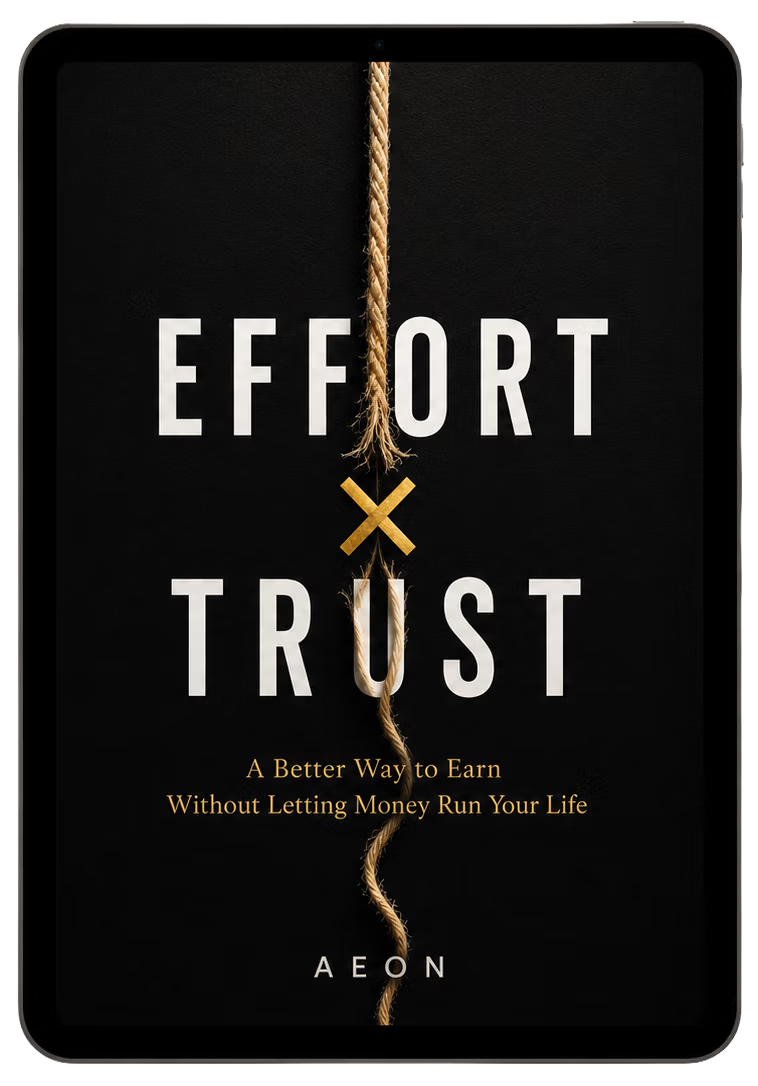
Ebook Only
$19
Just the book
The complete Effort × Trust framework, in full — ready to read in one sitting, whenever you need it.
Get the Ebook →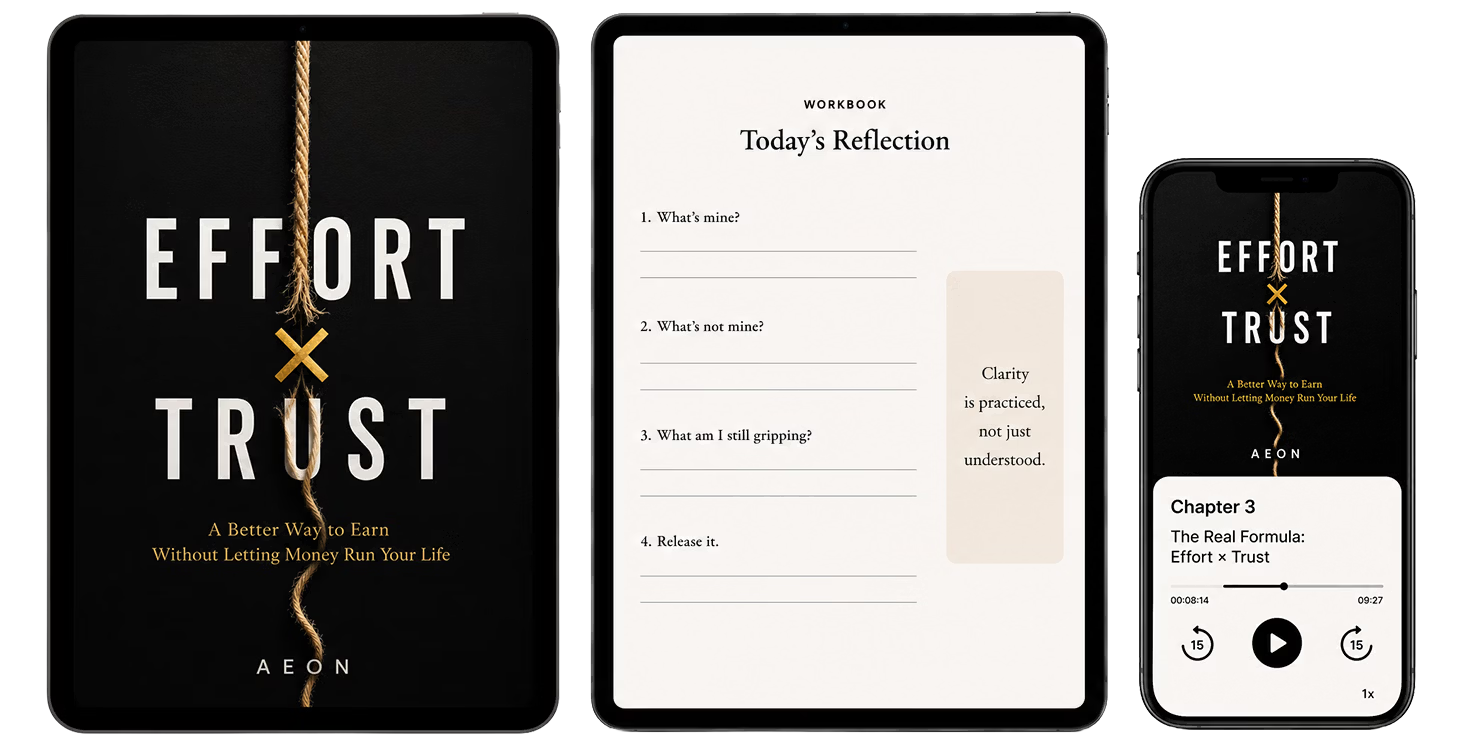
The Complete Edition
$34
Ebook + Audio + Workbook
Everything in the ebook, plus the audio version for whenever reading isn't an option, and the companion workbook — built around the same four-question loop — so the framework becomes a practice, not just an idea.
- The full ebook (PDF/EPUB)
- Complete audio version
- Companion workbook built on the four-question loop
One-time payment. Instant access. No subscriptions.
Frequently Asked Questions
A digital ebook (PDF/EPUB), readable on any phone, tablet, computer, or e-reader. The Complete Edition also includes an audio version and a companion workbook.
Around 15,000 words — built to be read in a single sitting, roughly the length of a long-haul flight or a quiet evening.
Instantly. After checkout, you'll get immediate access to download — no waiting, no shipping.
You can read Chapter 1 free before buying anything. If you do purchase and it turns out not to be a fit, you're covered by a 7-day refund — just reach out.
No. The book starts from the actual problem — burnout, overwork, uncertainty — and builds the framework from there. No prior reading required.
You've Been Missing Half the Formula.
Not more discipline. Not more letting go. Just the two, working together, the way they were always supposed to.
Get Effort × Trust →One-time payment. Instant access. Read Chapter 1 free if you haven't already.